Showing posts with label Travel Narratives. Show all posts

Thursday, April 25, 2013

Into the Wild


From the cover of Jon Krakauer's book:
In April 1992, a young man from a well-to-do family hitchhiked to Alaska and walked alone into the wilderness north of Mt. McKinley. He had given $25,000 in savings to a charity, abandoned his car and most of his possessions, burned all the cash in his wallet and invented a life for himself....
4 months later he was dead. Into the Wild is the story of Chris McCandless, in his early 20's when he died, told by a sympathetic writer who first told it in Outside magazine. The book is a page-turner, piecing together McCandless' life and travels with interviews from family, friends and folks he met on the road.

The story is controversial, with folks lining up on 2 basic sides:
side 1) what an idiot! unprepared, ignorant and arrogant.
side 2) what a brave, independent spirit! willing to strike out on his own like that. he'd be considered a hero if he had lived.
Krakauer is in the 2nd camp.

Kirkus Reviews calls it "A wonderful page-turner written with humility, immediacy, and great style." It has been adapted for film, but I'm not interested in seeing it.

Thursday, April 11, 2013

Seven Years In Tibet


Seven Years In Tibet is a 1952 travel narrative telling the story of Heinrich Harrer's escape from a British internment camp in India and his and his fellow inmate's attempts to enter Tibet. They were finally successful and spent several years in Lhasa where Harrer got to know the 14th (and current) Dalai Llama. The book ends with the Chinese invasion of Tibet.

This is a fascinating read, an interesting picture of a place now lost forever. There are some photographs, which add a lot to the reading. I think if there were a coffee table book with more and larger pictures, it would be well worth having. I haven't looked to see if such a thing exists.

There have been 2 films based on the book: the first is a 1956 documentary, and the second a 1997 film starring Brad Pitt.

from the back of the book:
The astonishing adventure classic about
life in hidden Tibet just before the Chinese
Communist takeover.
In this vivid memoir, Heinrich Harrer recounts his adventures as one of the first Europeans ever to enter Tibet. After escaping from a British internment camp in India during World War 11, Harrer trekked across Asia, ending up in the Forbidden City of Lhasa, penniless, and without proper permission to be in the area. But Tibetan hospitality and his own curious appearance worked in Harrer’s favour, allowing him unprecedented acceptance among the Tibetan upper classes –including a young Dalai Lama.

Thursday, March 07, 2013

The World of Venice


I used to read travel narratives on a regular basis. I'm not sure exactly when I stopped, but I realized I still had several on the shelf unread so decided to read them. Reading The World of Venice by Jan Morris reminds me why I used to love them so. It's a beautifully descriptive book, evocative of place and time. It was written in 1960 when the author was still James Morris. The copyright renewal in 1988 is under the name Jan Morris. This book's revision and foreword were written by Jan Morris. The author is 86 as of this writing and, according to Wikipedia, lives in Clevedon, Somerset, England, and considers herself Welsh. (I love Wikipedia as a starting place.)

My only difficulty with the book is picturing the author, who lived in Venice with his wife and children during the period this book was written. I had a few schizophrenic moments during my reading while I was trying to place the author in the scenes so vividly described. I don't have a strictly binary view of gender, but my reading experience with this book is illuminating to me. The Independent has an article on her personal life, which is interesting and informative. Though I don't tend to care about the personal lives of public figures, the name change made me curious, so I have read a bit about hers.

There are a few maps and some photographs in this edition. Ruskin is mentioned a few times. Many landmarks, works of art, deaths of visiting notables, and historical events are mentioned, which is expected, but the personal touch is always there, connecting us with the time and place. It names the Gobbo di Rialto (photo here) as "one of the best-known images of medieval Venice":


Morris describes it this way:
He stands now, abandoned and neglected, among a mass of boxes and old vegetables: a small hobbled granite figure of a man, supporting a flight of steps and a squat marble column. He used to be called a hunchback, but he is really only bent with burdens, for in the hey-day of the Rialto his responsibilities were great. Upon his pedestal the decrees of the Republic were promulgated, in the days when Venetian law was written in blood annd enforced with fire: and to his steps men convicted of petty crimes were forced to run naked from St. Mark's, hastened by a rain of blows, until at last, breathless, bleeding and humiliated, they fell chastened at his knobbly feet and embraced him in blind relief.
from the back of the book:
The World of Venice is a classic book that offers an incomparable take on an incomparable city. Jan Morris's new foreword brings readers up to date on 1990s Venice, a city "jam-packed with its admirers, jangling its profits, flaunting its theatrical splendors, enlivened once more by that old Venetian aphrodisiac -success." Incorporating the best aspects of travel writing and popular history, Morris transcends both genres by creating a composite portrait of Venice, artfully blending the fabled city's rich past with its current reality. Writing with singular zest and perceptiveness, Morris explores each of the city's aspects in all of its seasons, evoking the character of this unique locale through its arts, its food, and the personality of its people.
The Independent says,
In 1960, he published a cultural history of Venice, which established him as a major writer, and which has never been out of print. Its success brought in enough money for a switch from journalism to writing books full time. She has published about 40

Thursday, March 29, 2012

Notes from a Small Island


I had read Notes from a Small Island by Bill Bryson years ago but decided to re-read it before passing it on. It's a travel narrative, telling the story of a few weeks in the author's life spent wandering around Britain -mostly on foot and using public transportation- before he moves back to the U.S. with his family. Bryson has a nice sense of humor, but his descriptions aren't as vivid as some of the other travel writers I've read.

He does mention several other books, including Kingdom by the Sea, Tarka the Otter, In Search of England, The Road to Wigan Pier and Lost Resort: the Flow and Ebb of Morecombe. He also mentions a Wordsworth poem titled "I Can Be Boring Outside the Lake District Too". I found myself particularly interested in the 5th Duke of Portland, W.J.C. Scott-Bentinck (1800-1879) with his underground library nearly 250' long.

I wonder how Bryson can do all that walking and still not understand the purpose of tucking pant legs into socks, but maybe the ticks aren't so much a problem in Britain.

from the back of the book:
After nearly two decades spent on British soil, Bill Bryson -bestselling author of The Mother Tongue and Made in America- decided to return to the United States. ("I had recently read," Bryson writes, "that 3.7 million Americans believed that they had been abducted by aliens at one time or another,so it was clear that my people needed me.") But before departing, he set out on a grand farewell tour of the green and kindly island that had so long been his home.

Veering from the ludicrous to the endearing and back again, Notes from a Small Island is a delightfully irreverent jaunt around the unparalleled floating nation that has produced zebra crossings, Shakespeare, Twiggie Winkie's Farm, and places with names like Farleigh Wallop and Titsey. The result is an uproarious social commentary that conveys the true glory of Britain, from the satiric pen of an unapologetic Anglophile.


Kirkus Reviews calls it "A diverting travel journal". Lonely Planet doesn't like the author's "need to be cynical for the sake of being cynical and nothing more" and describes it as "a pretty average book". EW gives it a B- and closes by calling it "polite, unobtrusive, often charming, and quite easy to overlook."

Wednesday, February 24, 2010

Ibn Battuta

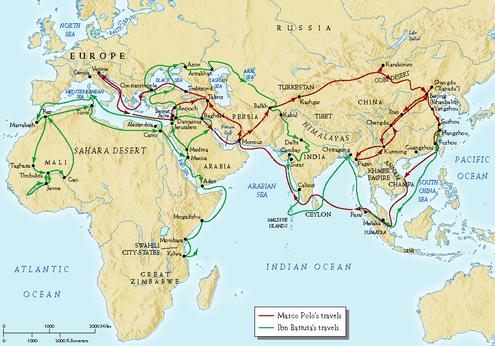
Today is the anniversary of the birth in 1304 of Ibn Battuta. I don't usually mark the birthdays of dead people, but we don't even know the year, much less the day, he died. I have been interested in travel narratives for years, and Ibn Battuta wrote a doozie! His travels covered a span of over 30 years and most of the known world of his day. Marco Polo was a rank amateur in comparison, and Ibn Battuta's writings are much more readable. There's a map here that compares the travels of the 2 men. You can read some of Ibn Battuta's work online. I have an old 1929 edition of selections from his writings that's part of the Argonaut Series edited by Sir E. Denison Ross and Eileen Power. Its introduction begins:
To the world of today the men of medieval Christendom already seem remote and unfamiliar. Their names and deeds are recorded in our history-books, their monuments still adorn our cities, but our kinship with them is a thing unreal, which costs an effort of imagination. How much more must this apply to the great Islamic civilization, that stood over against medieval Europe, menacing its existence and yet linked to it by a hundred ties that even war and fear could not sever. Its monuments too abide, for those who may have the fortunate to visit them, but its men and manners are to most of us utterly unknown, or dimly conceived in the romantic image of the Arabian Nights. Even for the specialist it is difficult to reconstruct their lives and see them as they were. Histories and biographies there are in quantity, but the historians for all their picturesque details, seldom show the ability to select the essential and to give their figures that touch of the intimate which makes them live again for the reader. It is in this faculty that Ibn Battuta excels.

This article (originally from Muslim Technologist, March 1990, but no longer available online) says
Ibn Battuta was the only medieval traveller who is known to have visited the lands of every Muslim ruler of his time. He also travelled in Ceylon (present Sri Lanka), China and Byzantium and South Russia. The mere extent of his travels is estimated at no less than 75,000 miles, a figure which is not likely to have been surpassed before the age of steam.

A public domain edition of Encyclopedia Brittanica has a narrative outline of the journey. There's a documentary travelogue
in which Tim Mackintosh-Smith follows in the footsteps of 14th Century Moroccan scholar Ibn Battutah, who covered 75,000 miles, 40 countries and three continents in a 30-year odyssey
You can watch the 1st part of that documentary online via youtube:

Monday, July 28, 2008

Roger Tory Peterson

Today is the anniversary of the death of naturalist Roger Tory Peterson, who wrote Guide to the Birds and edited or wrote many of the Peterson Field Guides. He and James Fisher co-wrote Wild America, the description of their trip around America.

He was awarded the Presidential Medal of Freedom in 1980. There is a short biography here. The National Wildlife Federation has a tribute article. The Harvard Museum of Natural History awards an annual medal named for him.

8/8/2008 is the centennial of Peterson's birth, and The Roger Tory Peterson Institute of Natural History is hosting a special exhibit and activities to celebrate. The Institute's mission
is to continue the legacy of Roger Tory Peterson by promoting the teaching and study of nature, and thereby to create knowledge of and appreciation and responsibility for the natural world.

Sunday, July 06, 2008

I Love Matt!

I remember "Where the Hell is Matt" in his first 2 videos. I find myself smiling through them every time I see them. Now there's a brand new one:

Why are these so captivating? Who knows. I know I find this one just as delightful as the first two. Check out 2:33 for my favorite part of this installment.

HT: Cinematical

7/31/2008:
Smart City Memphis interviews Matt.

Saturday, June 07, 2008

E. M. Forster


Today is the anniversary of the death in 1970 of author E. M. Forster. I do not think of this author as a contemporary, but he died not long before I started high school and that gives me a definite overlap with him. Best known for A Passage to India, A Room with a View and Howard's End, he also wrote short stories that dealt with science fictional or supernatural themes. Two short story collections are The Celestial Omnibus and Other Stories and The Eternal Moment and Other Stories. I read The Machine Stops from the latter collection and watched the one-hour tv show based on it about a year ago. He did not limit his writing to fiction, and among his other works are three books of travel writings. Some of his works are available online here . There is a short biography here.

Friday, May 16, 2008

Saint Brendan the Navigator


Today is the feast day of Saint Brendan the Navigator, who died around the year 577. I first heard of him when I heard of Tim Severin's re-enactment of Brendan's Voyage and the book he wrote telling the tale. The story of the original voyage is online here. More about St. Brendan: Patron Saints Index (he is the patron saint of whales) and the Catholic Encyclopedia.

This is an animated short film telling the story of Brendon's life:


Here's a folk song celebrating the voyage:

Thursday, May 01, 2008

David Livingstone


Today is the anniversary of the death in 1873 of David Livingstone, Scottish explorer and missionary. There is some confusion over whether he died on May 1 or May 4. His heart is buried in Africa.

Eyewitness to History has a report of Livingstone's discovery of Victoria Falls. Galenfrysinger has photos. There is a site here that is dedicated to him and fucuses on his medical work. Works by Livingstone are available online.

Friday, April 18, 2008

Thor Heyerdahl


Today is the anniversary of the death in 2002 of writer adventurer Thor Heyerdahl. I remember reading his book about the Kon-Tiki expedition and finding it fascinating. I read it several times while I was a teenager.

There is a page here that has information, photos and links. Go Norway has information in their Famous Norwegians section. The Bradshaw Foundation has excerpts from his lectures. The Kon-Tiki Museum has a web presence here.

The picture above is from Wikipedia.

Wednesday, April 02, 2008

Travel Narratives

Before 400 A.D.:

Luke/Acts as travel narrative
Egeria's Travels

Medieval Period:

Jerusalem
by F.E. Peters

Memoirs of the Crusades (1309)
by Geoffrey of Villehardouin

Memoirs
by Jean De Joinville

Travels
Sir John Mandeville (1322)

Travels
Marco Polo

The Journal of Friar Odoric

Ibn Battuta:
Ibn Battuta's Travels in Asia and Africa
translated and selected by H.A.R. Gibb
A Virtual Ibn Battuta Tour
Ibn Battuta video, part 1, part 2, part 3

Columbus' Log from his first voyage

1700's:

A New Voyage to Carolina
by John Lawson (d. 1711)

The Persian Letters
by Montesquieu

Letters (1716-1718)
Lady Mary Wortley Montagu

Letters of a Russian Traveler
by N.M. Karamzin

Tour Through the Eastern Counties of England (1722)
by Daniel Defoe

Journal of a Voyage to Lisbon (1755)
by Henry Fielding

Travels Through France and Italy (1766)
by Tobias Smollett

A Sentimental Journey Through France and Italy (1768)
by Laurence Sterne

A Journey to the Western Islands of Scotland (1775)
by Samuel Johnson

Journal of a Tour to the Hebrides (1785)
by James Boswell

Letters Written During a Short Residence in Sweden, Norway and Denmark (1796)
by Mary Wollstonecraft

1800's:

The Journals of Lewis and Clark (1804-1806)

Travels in Nubia (1822)
by John Lewis Burckhardt

A Journey through Persia, Armenia and Asia Minor to Constantinople (1808-1809)
A Second Journey through Persia to Constantinople (1810-1816)
by Justinian Morier

The Alhambra (1832)
by Washington Irving

Eothen (1834)
byA.W. Kinglake

The Voyage of the Beagle (1839)
by Charles Darwin

The Bible in Spain (1842)
by George Borrow

American Notes (1842)
Pictures From Italy (1846)
by Charles Dickens

The Logbook of the Captain's Clerk: Adventures in the China Seas
by John S. Sewell (1850)

English Traits (1856)
by Ralph Waldo Emerson

Missionary Travels (1857)
Zambesi Expedition (1865)
by David Livingstone

Women's Diaries of the Westward Journey
by Lillian Schlissel (1841-1867)

Innnocents Abroad (1869)
by Mark Twain

An Inland Voyage (1876);
Travels With a Donkey (1878);
The Amateur Emigrant (1879)
by R.L. Stevenson

A Little Tour in France (1882)
by Henry James

Around the World on a Bicycle (1887)
volume 1
volume 2
by Thomas Stevens

Travels in Arabia Deserta (1888)
volume 1, abridged
volume 2, abridged
by Charles M. Doughty

American Notes
by Rudyard Kipling (1891)

Across the Plains (1892);
The Silverado Squatters (1892?)
by R.L. Stevenson

Eight Years' Wanderings in Ceylon
by Samuel White Baker (d. 1893)

Among the Tibetans (1894)
by Isabella L. Bird

A Tuscan Shrine (1895)
by Edith Wharton

The Country of the Painted Firs (1896)
by Sarah Orne Jewett

Following the Equator (1897)
by Mark Twain

The White Nile (1850-1900)
by Alan Moorehead

Travels in West Africa (1897)
by Mary Kingsley

1900's:

The Sea and the Jungle (1909-1910)
by H.M. Tomlinson

Cruise of the Snark (1911)
by Jack London

Fighting France (1915)
by Edith Wharton

Seven Pillars of Wisdom (1916)
by T.E. Lawrence

The Endurance (1914-1916)
by Caroline Alexander

South From Granada: A Sojourn in Southern Spain (1920-1934)
by Gerald Brenan

The Royal Road to Romance (1925)
by Richard Halliburton


The Man-Eaters of Tsavo and Other East-African Adventures (1925)
by J.H. Patterson

The Glorious Adventure (1927)
by Richard Halliburton (retracing Ulysses' voyage)

When the Going Was Good (1929-1935)
by Evelyn Waugh

In the Steps of the Master (early 1930's)
by H.V. Morton

Journey Without Maps (1936)
by Graham Greene

The Road to Oxiana (1937)
by Robert Byron

Out of Africa (1937)
by Isak Dinesen

The Road to Wigan Pier (1937)
by George Orwell

Complete Book of Marvels (1937-1938)
by Richard Halliburton

The Log from the Sea of Cortez (1941)
by John Steinbeck

Man-Eaters of Kumaon (1944)
by Jim Corbett

The Road Back to Paris (1944)
by A.J. Liebling

Kon-Tiki,; Across the Pacific by Raft (1950)
by Thor Heyerdahl

Beyond the High Himalayas (1952)
by William O. Douglas

Bitter Lemons (1953-1956)
by Lawrence Durrell

Normandy Revisited (1958)
by A.J. Liebling

A Short Walk in the Hindu Kush (1958)
by Eric Newby

Travels With Charley (1961)
by John Steinbeck

Gipsy Moth Circles the World (1967)
by Sir Francis Chichester

Notes From the Century Before: A Journal From British Columbia (1969)
by Edward Hoagland

The Longest Mile: A vivid chronicle of life in an Appalachian hollow (1969)
by Rena Gazaway

The Ra Expeditions (1970)
by Thor Heyerdahl

The Great Railway Bazaar: By Train Through Asia (1975)
by Paul Theroux

Behind the Wall (1976)
by Colin Thubron

In Patagonia (1977)
by Bruce Chatwin

The Brendan Voyage: A Leather Boat Tracks the Discovery of America by the Irish Sailor Saints (1978)
by Tim Severin

The Snow Leopard (1978)
by Peter Matthiessen

Travel writings
by Kathleen Ann Goonan (1980's)

Blue Highways: A Journey Into America (1982)
by William Least Heat Moon

The Kingdom by the Sea: A Journey Around Great Britain (1983)
by Paul Theroux

A Year in Provence (1989)
by Peter Mayle

Down the Volga: A Journey Through Mother Russia in a Time of Troubles (1991)
by Marq de Villiers

PrairyErth (1991)
by William Least Heat Moon

Following the Brush (1993)
by John Elder

Falling off the Map: Some Lonely Places of the World (1993)
by Pico Iyer

Ramblings of Wo Gege: a China Travel Narrative (1994)

Notes From a Small Island (1995)
by Bill Bryson

No Mercy: A Journey To the Heart of the Congo (1996)
by Redmond O'Hanlon

Badland (1996)
by Jonathan Raban

Into Thin Air (1996)
by Jon Krakauer

Thomas Cook Travel Book Award (1980-2004)

86 Greatest Travel Books of All Time by Longitude.com (a bookseller, but still)

Monday, March 24, 2008

Richard Halliburton


Richard Halliburton was presumed dead after this date in 1939, a tragic loss. The West Tennessee native, who grew up in Memphis, was an adventure traveler and author. The Memphis Commercial Appeal has a recent article on Halliburton. His travel narratives have been favorites of ours since we discovered them when the kids were quite young. Finding out how he died was traumatic.


The photo above is from Wikipedia and is used here to illustrate this remembrance.

Monday, January 21, 2008

George Orwell

Today is the anniversary of the death in 1950 of George Orwell, pen name of Eric Arthur Blair. There is a documentary on his life and works at youtube: part 1, part 2, part 3, part 4, part 5 and part 6. I discovered his writings in high school, reading Animal Farm and Nineteen Eighty-Four for English class.

Animal Farm has been adapted for the screen several times, beginning in 1954 with an animated version:

This one has been dubbed for a foreign market and doesn't have English subtitles, but it is available in the original English on DVD from amazon.com. This video shows the type of animation used, though. {7/27/2008: That video is not currently available, but it's available in English in 4 parts part 1 here, part 2 here, part 3 here and part 4 here.) 1001 Flicks has a review.

There was also a made-for-tv Hallmark version in 1999:


Nineteen Eighty-Four has also been adapted for film, beginning with a 1956 version starring Edmond O'Brien (who starred in D.O.A.) and Donald Pleasence (who was Melchior in the made-for-tv Jesus of Nazareth). There was a version made in, of course, 1984 with John Hurt and Richard Burton:


George Orwell didn't just write science fiction and fantasy novels. The Road to Wigan Pier is a 1937 first-hand exploration of the hard life of the working class in England's industrial north. It can be read online here.

5/12/2009: The House Next Door has a long and interesting article.

Friday, December 14, 2007

Louis Agassiz


Today is the anniversary of the death in 1873 of Louis Agassiz. I discovered Louis Agassiz when I was doing a series of readings in Natural History. He was the first to propose in a scientific journal the theory that there had been an early ice age. There is a short biography and an overview here, here and here. The Victorian Web has a page on him. He wrote what really amounts to a travel narrative in his 1868 A Journey in Brazil.

Monday, December 03, 2007

Robert Louis Stevenson


Today is the anniversary of the death in 1894 of Robert Louis Stevenson. I discovered Stevenson when young and introduced him to my children when they were young, though they never liked A Child's Garden of Verses like I did. Treasure Island was our favorite, which probably places us squarely with the majority of his readers.

I discovered his travel writing after the kids were school-aged and wonder why they aren't better known, unless it's just that travel narratives seem less-read than fiction. I have these: An Inland Voyage and Travels with a Donkey in the Cévennes published together in a volume of The Gateway Series of English Texts; and The Amateur Emigrant, Across the Plains and The Silverado Squatters in The Travels and Essays of Robert Louis Stevenson.

I have a soft spot in my heart for Stevenson because of his defense of Father Damien. It endears him to me.

Thursday, October 11, 2007

Doris Lessing Wins Nobel Prize

Doris Lessing has won the Nobel Prize for literature. I'm excited about this. I keep an eye on news items about her and saw the news through google. The Nobel Prize site describes her as:

"that epicist of the female experience, who with scepticism, fire and visionary power has subjected a divided civilisation to scrutiny"


They mentioned The Golden Notebook in particular in discussing the reason for the award.

Her sff works include the Canopus in Argos series, Mara and Dann and her most recent novel The Cleft.

Her website is here. There is information on her at Contemporary Writers, kirjasto.sci.fi and BBC World Service. Salon.com interviewed her in 1997.

More:

GreenCine

The New York Times:
Ms. Lessing, who turns 88 later this month, never finished high school and largely educated herself through her voracious reading. She had been born to British parents in what is now Iran, was raised in colonial Rhodesia (now Zimbabwe) and now lives in London. She has written dozens of books of fiction, as well as plays, non-fiction and an autobiography. She is the 11th woman to win a Nobel Prize in literature.

NYT links page

AP

Reuters

Bloomberg

Guardian Unlimited

Library Journal

New York Times

Science Fiction Awards Watch

Edward Copeland

SFSignal

SFScope

Boing Boing

Trufen #1, where they share the news of the award.

Trufen #2, where they share the author's reaction.

Trufen links to this story, which says in part:
Lessing, who turns 88 this month, is the oldest winner of the literature prize. Although she is widely celebrated for "The Golden Notebook" and other works, she has received little attention in recent years and has been criticized as strident and eccentric.

Asked repeatedly if she was excited about the award, she held court from her doorstep and noted she had been in the running for the Nobel for decades.

"I can't say I'm overwhelmed with surprise," Lessing said. "I'm 88 years old and they can't give the Nobel to someone who's dead, so I think they were probably thinking they'd probably better give it to me now before I've popped off."


I kinda like strident and eccentric, and I like the books that I've read by her. I got a kick out of that story.

Paste Magazine quotes an unappreciative Harold Bloom:
Many considered it a surprise decision, including Lessing herself, evidently. American literary critic Harold Bloom was particularly shocked by the announcement. He derided the academy's selection as "pure political correctness."

"Although Ms. Lessing at the beginning of her writing career had a few admirable qualities, I find her work for the past 15 years quite unreadable ... fourth-rate science fiction," Bloom told the Associated Press.

Alas, you can't please everyone.


NPR

10/12/2007:

Mumpsimus has some personal reflections.

SciFiScanner

Bill Moyers Journal

10/14/2007:

SFAwardsWatch

10/20/2007:

World Hum discusses Lessing's travel writing.

Saturday, August 25, 2007

Star Trek Travelers

World Hum has a list of the 10 greatest fictional travelers, and 5th on the list (I know, that's what I thought: FIFTH? Humph!) is the original series Enterprise crew.

What serious traveler doesn’t want to explore strange new worlds? To seek out new civilizations? To boldly go?


But I can't quite get past being 5th when #1 was Sal Paradise from Kerouac's “On the Road”.

In the comments are suggestions to include the kids from Ransome's wonderful Swallows and Amazons books, the time traveler from H.G. Wells' The Time Machine, Tolkien's Frodo, Dorothy from The Wizard of Oz, Ford Prefect from The Hitchhiker’s Guide to the Galaxy, Alice from Through the Looking Glass and the children from the Narnia books.

Travelers, indeed. And I think of a 2-week vacation as a long trip.

Friday, June 29, 2007

Tour Karnak

Take a virtual tour of Karnak. Not the same as being there, of course, but maybe vicarious travel is better than no travel at all?

Here's a video tour in 2 parts:


Friday, February 16, 2007

Travel Narratives Online

I read the blog Wise Bread: living large on a small budget and saw a post there today on how to be a cheap reader. I tend to prefer hard copies of books. I like to prop up in bed and turn the pages of a used book, so I haunt the local used book stores to feed my passion. If I did want to read books from a computer screen, though, Wise Bread has a link to a site that has links to travel narratives online: Explorion. There are wonderful things there! They have Dickens' Pictures From Italy, Powell's Canyons of the Cororado, Henry James' Italian Hours, Mungo Park's Travels In Central Africa, Isabella Bird's Among the Tibetans, Francis Parkman's The Oregon Trail, William Bartram's Travels, Kinglake's Eothen, Stanley's How I Found Livingstone, The Journals of Lewis and Clark, The Itinerary of Benjamin of Tudela (which led me a merry chase before I finally gave up finding a hard copy), Burton's Personal Narrative of a Pilgrimage to Al-Madinah and Meccah, Mary Kingsley's Travels in West Africa and just entirely too many others to mention.

I have hard copies of some of the books listed on this site but nowhere near all, and I'm inspired to seek some out that I've never paid much attention to before.

There is a wikipedia article here which contains some general information about this literary genre, including a list of notable works. Longitude Books has a great selection and has sections on "Neglected Classics" and "Favorites" and has book recommendations divided by region.