Friday, July 31, 2020

The Lerouge Case

Émile Gaboriau (1832 - 1873), french novelist, one of the first crime fiction writers

The Lerouge Case is an 1866 detective novel by Émile Gaboriau, the first detective novel he wrote. I'm surprised some of these old detectives have fallen into obscurity while others -I'm looking at you, Sherlock Holmes- continue to capture the public imagination. This is a fine tale, with interesting characters and a plot that will hold your attention. According to Wikipedia, it
introduced an amateur detective. It also introduced a young police officer named Monsieur Lecoq, who was the hero in three of Gaboriau's later detective novels. The character of Lecoq was based on a real-life thief turned police officer, Eugène François Vidocq (1775–1857), whose own memoirs, Les Vrais Mémoires de Vidocq, mixed fiction and fact...
You can read it online here. It begins,
CHAPTER I.

On Thursday, the 6th of March, 1862, two days after Shrove Tuesday, five women belonging to the village of La Jonchere presented themselves at the police station at Bougival.

They stated that for two days past no one had seen the Widow Lerouge, one of their neighbours, who lived by herself in an isolated cottage. They had several times knocked at the door, but all in vain. The window-shutters as well as the door were closed; and it was impossible to obtain even a glimpse of the interior.

This silence, this sudden disappearance alarmed them. Apprehensive of a crime, or at least of an accident, they requested the interference of the police to satisfy their doubts by forcing the door and entering the house.

Bougival is a pleasant riverside village, peopled on Sundays by crowds of boating parties. Trifling offences are frequently heard of in its neighbourhood, but crimes are rare.

The commissary of police at first refused to listen to the women, but their importunities so fatigued him that he at length acceded to their request. He sent for the corporal of gendarmes, with two of his men, called into requisition the services of a locksmith, and, thus accompanied, followed the neighbours of the Widow Lerouge.

La Jonchere owes some celebrity to the inventor of the sliding railway, who for some years past has, with more enterprise than profit, made public trials of his system in the immediate neighbourhood. It is a hamlet of no importance, resting upon the slope of the hill which overlooks the Seine between La Malmaison and Bougival. It is about twenty minutes’ walk from the main road, which, passing by Rueil and Port-Marly, goes from Paris to St. Germain, and is reached by a steep and rugged lane, quite unknown to the government engineers.

The party, led by the gendarmes, followed the main road which here bordered the river until it reached this lane, into which it turned, and stumbled over the rugged inequalities of the ground for about a hundred yards, when it arrived in front of a cottage of extremely modest yet respectable appearance. This cottage had probably been built by some little Parisian shopkeeper in love with the beauties of nature; for all the trees had been carefully cut down. It consisted merely of two apartments on the ground floor with a loft above. Around it extended a much-neglected garden, badly protected against midnight prowlers, by a very dilapidated stone wall about three feet high, and broken and crumbling in many places. A light wooden gate, clumsily held in its place by pieces of wire, gave access to the garden.

“It is here,” said the women.

The commissary stopped. During his short walk, the number of his followers had been rapidly increasing, and now included all the inquisitive and idle persons of the neighbourhood. He found himself surrounded by about forty individuals burning with curiosity.

“No one must enter the garden,” said he; and, to ensure obedience, he placed the two gendarmes on sentry before the entrance, and advanced towards the house, accompanied by the corporal and the locksmith.

He knocked several times loudly with his leaded cane, first at the door, and then successively at all the window shutters. After each blow, he placed his ear against the wood and listened. Hearing nothing, he turned to the locksmith.

“Open!” said he.

The workman unstrapped his satchel, and produced his implements. He had already introduced a skeleton key into the lock, when a loud exclamation was heard from the crowd outside the gate.

“The key!” they cried. “Here is the key!”

A boy about twelve years old playing with one of his companions, had seen an enormous key in a ditch by the roadside; he had picked it up and carried it to the cottage in triumph.

“Give it to me youngster,” said the corporal. “We shall see.”

The key was tried, and it proved to be the key of the house.

The commissary and the locksmith exchanged glances full of sinister misgivings. “This looks bad,” muttered the corporal. They entered the house, while the crowd, restrained with difficulty by the gendarmes, stamped with impatience, or leant over the garden wall, stretching their necks eagerly, to see or hear something of what was passing within the cottage.

Those who anticipated the discovery of a crime, were unhappily not deceived. The commissary was convinced of this as soon as he crossed the threshold. Everything in the first room pointed with a sad eloquence to the recent presence of a malefactor. The furniture was knocked about, and a chest of drawers and two large trunks had been forced and broken open.

In the inner room, which served as a sleeping apartment, the disorder was even greater. It seemed as though some furious hand had taken a fiendish pleasure in upsetting everything. Near the fireplace, her face buried in the ashes, lay the dead body of Widow Lerouge. All one side of the face and the hair were burnt; it seemed a miracle that the fire had not caught her clothing.

“Wretches!” exclaimed the corporal. “Could they not have robbed, without assassinating the poor woman?”

“But where has she been wounded?” inquired the commissary, “I do not see any blood.”

“Look! here between the shoulders,” replied the corporal; “two fierce blows, by my faith. I’ll wager my stripes she had no time to cry out.”

He stooped over the corpse and touched it.

“She is quite cold,” he continued, “and it seems to me that she is no longer very stiff. It is at least thirty-six hours since she received her death-blow.”

The commissary began writing, on the corner of a table, a short official report.

“We are not here to talk, but to discover the guilty,” said he to the corporal. “Let information be at once conveyed to the justice of the peace, and the mayor, and send this letter without delay to the Palais de Justice. In a couple of hours, an investigating magistrate can be here. In the meanwhile, I will proceed to make a preliminary inquiry.”

“Shall I carry the letter?” asked the corporal of gendarmes.

“No, send one of your men; you will be useful to me here in keeping these people in order, and in finding any witnesses I may want. We must leave everything here as it is. I will install myself in the other room.”

A gendarme departed at a run towards the station at Rueil; and the commissary commenced his investigations in regular form, as prescribed by law.

“Who was Widow Lerouge? Where did she come from? What did she do? Upon what means, and how did she live? What were her habits, her morals, and what sort of company did she keep? Was she known to have enemies? Was she a miser? Did she pass for being rich?”

The commissary knew the importance of ascertaining all this: but although the witnesses were numerous enough, they possessed but little information. The depositions of the neighbours, successively interrogated, were empty, incoherent, and incomplete. No one knew anything of the victim, who was a stranger in the country. Many presented themselves as witnesses moreover, who came forward less to afford information than to gratify their curiosity. A gardener’s wife, who had been friendly with the deceased, and a milk-woman with whom she dealt, were alone able to give a few insignificant though precise details.

In a word, after three hours of laborious investigation, after having undergone the infliction of all the gossip of the country, after receiving evidence the most contradictory, and listened to commentaries the most ridiculous, the following is what appeared the most reliable to the commissary.

Thursday, July 30, 2020

The Last Starship

The Last Starship is a 2016 science fiction film. You can watch it free at tubitv or Crackle or Amazon Prime. Give it a chance if you like science fiction.

trailer:

Wednesday, July 29, 2020

Slip Away

Slip Away:


James Govan at the Rum Boogie Cafe on Beale Street in Memphis TN. He was a frequent performer there. He was 64 when he died on July 18, 2014.

Tuesday, July 28, 2020

Outward Bound

Outward Bound is a 1930 fantasy drama starring Leslie Howard (in his first feature-length sound film) and Douglas Fairbanks Jr. This is a touching and encouraging film. I watched it online but can't find it now. It's quite frustrating when a movie like this is still under copyright and unavailable for viewing. I don't understand it.

This trailer will give you a taste:


This screenshot from the film has a drink on the table as these two share a moment:


Today is the day for the T Stands for Tuesday blogger gathering. I've been out of town for several days and am so far behind I'll never catch up, so I'm not sharing my link there. See y'all next week if not before.

Monday, July 27, 2020

Lazarus Laughed

The Resurrection of Lazarus. Byzantine icon, late 14th – early 15th century


Lazarus Laughed is a 1925 play by Eugene O'Neill. Generally, I much prefer seeing a play performed to reading it. O'Neill is an exception. I discovered his plays in high school and read what was available in our school's library with great enjoyment.

from Wikipedia: " It is a long theo-philosophical meditation with more than a hundred actors making up a masked chorus. In theatrical format, Lazarus Laughed appears to be a Greek tragedy. But the underlying message is similar to the mystery plays from the Middle Ages." It has never been filmed and is only rarely performed. You can read this one online here. It begins,
Lazarus Laughed


ACT ONE


SCENE ONE


SCENE--Exterior and interior of Lazarus' home at Bethany. The main room at the front end of the house is shown--a long, low-ceilinged, sparely furnished chamber, with white walls gray in the fading daylight that enters from three small windows at the left. To the left of center several long tables placed lengthwise to the width of the room, around which many chairs for guests have been placed. In the rear wall, right, a door leading into the rest of the house. On the left, a doorway opening on a road where a crowd of men has gathered. On the right, another doorway leading to the yard where there is a crowd of women.

Inside the house, on the men's side, seven male Guests are grouped by the door, watching Lazarus with frightened awe, talking hesitantly in low whispers. The Chorus of Old Men, seven in number, is drawn up in a crescent, in the far corner, right, facing Lazarus.

(All of these people are masked in accordance with the following scheme: There are seven periods of life shown: Boyhood [or Girlhood], Youth, Young Manhood [or Womanhood], Manhood [or Womanhood], Middle Age, Maturity and Old Age; and each of these periods is represented by seven different masks of general types of character as follows: The Simple, Ignorant; the Happy, Eager; the Self-Tortured, Introspective; the Proud, Self-Reliant; the Servile, Hypocritical; the Revengeful, Cruel; the Sorrowful, Resigned. Thus in each crowd [this includes among the men the Seven Guests who are composed of one male of each period-type as period one--type one, period two--type two, and so on up to period seven--type seven] there are forty-nine different combinations of period and type. Each type has a distinct predominant color for its costumes which varies in kind according to its period. The masks of the Chorus of Old Men are double the size of the others. They are all seven in the Sorrowful, Resigned type of Old Age.)

On a raised platform at the middle of the one table placed lengthwise at center sits Lazarus, his head haloed and his body illumined by a soft radiance as of tiny phosphorescent flames.

Lazarus, freed now from the fear of death, wears no mask.

In appearance Lazarus is tall and powerful, about fifty years of age, with a mass of gray-black hair and a heavy beard. His face recalls that of a statue of a divinity of Ancient Greece in its general structure and particularly in its quality of detached serenity. It is dark-complected, ruddy and brown, the color of rich earth upturned by the plow, calm but furrowed deep with the marks of former suffering endured with a grim fortitude that had never softened into resignation. His forehead is broad and noble, his eyes black and deep-set. Just now he is staring straight before him as if his vision were still fixed beyond life.

Kneeling beside him with bowed heads are his wife, Miriam, his sisters, Martha and Mary, and his Father and Mother.

Miriam is a slender, delicate woman of thirty-five, dressed in deep black, who holds one of his hands in both of hers, and keeps her lips pressed to it. The upper part of her face is covered by a mask which conceals her forehead, eyes and nose, but leaves her mouth revealed. The mask is the pure pallor of marble, the expression that of a statue of Woman, of her eternal acceptance of the compulsion of motherhood, the inevitable cycle of love into pain into joy and new love into separation and pain again and the loneliness of age. The eyes of the mask are almost closed. Their gaze turns within, oblivious to the life outside, as they dream down on the child forever in memory at her breast. The mouth of Miriam is sensitive and sad, tender with an eager, understanding smile of self-forgetful love, the lips still fresh and young. Her skin, in contrast to the mask, is sunburned and earth-colored like that of Lazarus. Martha, Mary and the two parents all wear full masks which broadly reproduce their own characters. Martha is a buxom middle-aged housewife, plain and pleasant. Mary is young and pretty, nervous and high-strung. The Father is a small, thin, feeble old man of over eighty, meek and pious. The Mother is tall and stout, over sixty-five, a gentle, simple woman.

All the masks of these Jews of the first two scenes of the play are pronouncedly Semitic.

A background of twilight sky. A dissolving touch of sunset still lingers on the horizon.

It is some time after the miracle and Jesus has gone away.


CHORUS OF OLD MEN--(in a quavering rising and falling chant--their arms outstretched toward Lazarus)

Jesus wept!
Behold how he loved him!
He that liveth,
He that believeth,
Shall never die!

CROWD--(on either side of house, echo the chant)

He that believeth
Shall never die!
Lazarus, come forth!

FIRST GUEST--(a Simple Boy--in a frightened whisper after a pause of dead silence) That strange light seems to come from within him! (with awe) Think of it! For four days he lay in the tomb! (turns away with a shudder)

SECOND GUEST--(a Happy Youth--with reassuring conviction) It is a holy light. It came from Jesus.

FIFTH GUEST--(an Envious, Middle-Aged Man) Maybe if the truth were known, our friend there never really died at all!

FOURTH GUEST--(a Defiant Man, indignantly) Do you doubt the miracle? I tell you I was here in this house when Lazarus died!

SEVENTH GUEST--(an Aged, Sorrowful Man) And I used to visit him every day. He knew himself his hour was near.

FOURTH GUEST--He wished for death! He said to me one day: "I have known my fill of life and the sorrow of living. Soon I shall know peace." And he smiled. It was the first time I had seen him smile in years.

THIRD GUEST--(a Self-Tortured Man--gloomily) Yes, of late years his life had been one long misfortune. One after another his children died--

SIXTH GUEST--(a Mature Man with a cruel face--with a harsh laugh) They were all girls. Lazarus had no luck.

SEVENTH GUEST--The last was a boy, the one that died at birth. You are forgetting him.

THIRD GUEST--Lazarus could never forget. Not only did his son die but Miriam could never bear him more children.

FIFTH GUEST--(practically) But he could not blame bad luck for everything. Take the loss of his father's wealth since he took over the management. That was his own doing. He was a bad farmer, a poor breeder of sheep, and a bargainer so easy to cheat it hurt one's conscience to trade with him!

SIXTH GUEST--(with a sneer--maliciously) You should know best about that! (a suppressed laugh from those around him)

FIRST GUEST--(who has been gazing at Lazarus--softly) Ssssh! Look at his face! (They all stare. A pause.)

SECOND GUEST--(with wondering awe) Do you remember him, neighbors, before he died? He used to be pale even when he worked in the fields. Now he seems as brown as one who has labored in the earth all day in a vineyard beneath the hot sun! (a pause)

FOURTH GUEST--The whole look of his face has changed. He is like a stranger from a far land. There is no longer any sorrow in his eyes. They must have forgotten sorrow in the grave.

FIFTH GUEST--(grumblingly) I thought we were invited here to eat--and all we do is stand and gape at him!

FOURTH GUEST--(sternly) Be silent! We are waiting for him to speak.

THIRD GUEST--(impressively) He did speak once. And he laughed!

ALL THE GUESTS--(amazed and incredulous) Laughed?

THIRD GUEST--(importantly) Laughed! I heard him! It was a moment after the miracle--

MIRIAM--(her voice, rich with sorrow, exultant now) Jesus cried, "Lazarus, come forth!" (She kisses his hand. He makes a slight movement, a stirring in his vision. The Guests stare. A frightened pause.)

FIFTH GUEST--(nudging the Second--uneasily) Go on with your story!

THIRD GUEST--Just as he appeared in the opening of the tomb, wrapped in his shroud--

SECOND GUEST--(excitedly--interrupting) My heart stopped! I fell on my face! And all the women screamed! (sceptically) You must have sharp ears to have heard him laugh in that uproar!

THIRD GUEST--I helped to pry away the stone so I was right beside him. I found myself kneeling, but between my fingers I watched Jesus and Lazarus. Jesus looked into his face for what seemed a long time and suddenly Lazarus said "Yes" as if he were answering a question in Jesus' eyes.

ALL THE GUESTS--(mystified) Yes? What could he mean by yes?

THIRD GUEST--Then Jesus smiled sadly but with tenderness, as one who from a distance of years of sorrow remembers happiness. And then Lazarus knelt and kissed Jesus' feet and both of them smiled and Jesus blessed him and called him "My Brother" and went away; and Lazarus, looking after Him, began to laugh softly like a man in love with God! Such a laugh I never heard! It made my ears drunk! It was like wine! And though I was half-dead with fright I found myself laughing, too!

MIRIAM--(with a beseeching summons) Lazarus, come forth!

CHORUS--(chanting) Lazarus! Come forth!

CROWD--(on either side of the house--echoing the chant) Come forth! Come forth!

LAZARUS--(suddenly in a deep voice--with a wonderful exultant acceptance in it) Yes! (The Guests in the room, the Crowds outside all cry out in fear and joy and fall on their knees.)

CHORUS--(chanting exultantly)

The stone is taken away!
The spirit is loosed!
The soul let go!

LAZARUS--(rising and looking around him at everyone and everything--with an all-embracing love--gently) Yes! (His family and the Guests in the room now throng about Lazarus to embrace him. The Crowds of men and women on each side push into the room to stare at him. He is in the arms of his Mother and Miriam while his Sisters and Father kiss and press his hands. The five are half hysterical with relief and joy, sobbing and laughing.)

FATHER--My son is reborn to me!

CHORUS--Hosannah!

ALL--(with a great shout) Hosannah!

FATHER--Let us rejoice! Eat and drink! Draw up your chairs, friends! Music! Bring wine! (Music begins in the room off right, rear--a festive dance tune. The company sit down in their places, the Father and Mother at Lazarus' right and left, Miriam next to the Mother, Martha and Mary beside the Father. But Lazarus remains standing. And the Chorus of Old Men remain in their formation at the rear. Wine is poured and all raise their goblets toward Lazarus--then suddenly they stop, the music dies out, and an awed and frightened stillness prevails, for Lazarus is a strange, majestic figure whose understanding smile seems terrible and enigmatic to them.)

FATHER--(pathetically uneasy) You frighten us, my son. You are strange--standing there--(In the midst of a silence more awkward than before he rises to his feet, goblet in hand--forcing his voice, falteringly) A toast, neighbors!

CHORUS--(in a forced echo) A toast!

ALL--(echoing them) A toast!

FATHER--To my son, Lazarus, whom a blessed miracle has brought back from death!

LAZARUS--(suddenly laughing softly out of his vision, as if to himself, and speaking with a strange unearthly calm in a voice that is like a loving whisper of hope and confidence) No! There is no death! (A moment's pause. The people remain with goblets uplifted, staring at him. Then all repeat after him questioningly and frightenedly)

ALL--There--is--no--death?

SIXTH GUEST--(suddenly blurts out the question which is in the minds of all) What did you find beyond there, Lazarus? (a pause of silence)

LAZARUS--(smiles gently and speaks as if to a group of inquisitive children) O Curious Greedy Ones, is not one world in which you know not how to live enough for you?

SIXTH GUEST--(emboldened) Why did you say yes, Lazarus?

FOURTH GUEST--Why did you laugh?

ALL THE GUESTS--(with insistent curiosity but in low awed tones) What is beyond there, Lazarus?

CHORUS--(in a low murmur) What is beyond there? What is beyond?

CROWD--(carrying the question falteringly back into silence) What is beyond?

LAZARUS--(suddenly again--now in a voice of loving exaltation) There is only life! I heard the heart of Jesus laughing in my heart; "There is Eternal Life in No," it said, "and there is the same Eternal Life in Yes! Death is the fear between!" And my heart reborn to love of life cried "Yes!" and I laughed in the laughter of God! (He begins to laugh, softly at first--a laugh so full of a complete acceptance of life, a profound assertion of joy in living, so devoid of all self-consciousness or fear, that it is like a great bird song triumphant in depths of sky, proud and powerful, infectious with love, casting on the listener an enthralling spell. The Crowd in the room are caught by it. Glancing sideways at one another, smiling foolishly and self-consciously, at first they hesitate, plainly holding themselves in for fear of what the next one will think.)

CHORUS--(in a chanting murmur)

Lazarus laughs!
Our hearts grow happy!
Laughter like music!
The wind laughs!
The sea laughs!
Spring laughs from the earth!
Summer laughs in the air!
Lazarus laughs!

LAZARUS--(on a final note of compelling exultation) Laugh! Laugh with me! Death is dead! Fear is no more! There is only life! There is only laughter!

CHORUS--(chanting exultingly now)

Laugh! Laugh!
Laugh with Lazarus!
Fear is no more!
There is no death!

(They laugh in a rhythmic cadence dominated by the laughter of Lazarus.)

CROWD--(who, gradually, joining in by groups or one by one--including Lazarus' family with the exception of Miriam, who does not laugh but watches and listens to his laughter with a tender smile of being happy in his happiness--have now all begun to laugh in rhythm with the Chorus--in a great, full-throated pæan as the laughter of Lazarus rises higher and higher)

Laugh! Laugh!
Fear is no more!
There is no death!

CHORUS--

Laugh! Laugh!
There is only life!
There is only laughter!
Fear is no more!
Death is dead!

CROWD--(in a rhythmic echo)

Laugh! Laugh!
Death is dead!
There is only laughter!

(The room rocks, the air outside throbs with the rhythmic beat of their liberated laughter--still a bit uncertain of its freedom, harsh, discordant, frenzied, desperate and drunken, but dominated and inspired by the high, free, aspiring, exulting laughter of Lazarus.)

(Curtain)

Sunday, July 26, 2020

The Dark Crystal

The Dark Crystal is a 1982 fantasy film, a delight in every way. If you've never seen it you've really missed out on a modern treasure. It's a favorite here among every age group.

trailer:

Saturday, July 25, 2020

The Faerie Queen


The Faerie Queene by Edmund Spenser is an epic poem written in 1590. It is notable for its form -it is one of the longest poems in the English language- as well as for being the work in which Spenser invented the verse form known as the Spenserian stanza. It was written in language considered obsolete even in its day and is now read almost entirely in adapted versions like the illustrated prose adaptation by Douglas Hill pictured above. That's the one I read, and it's a lovely choice. I think some version of this should be read at least once by everyone who claims English as their native tongue.

Mary Macleod's 1916 re-telling is online here. It begins,
The Red Cross Knight
"Right faithful true he was in deed and word"

The Court of the Queen


ONCE upon a time, in the days when there were still such things as giants and dragons, there lived a great Queen. She reigned over a rich and beautiful country, and because she was good and noble every one loved her, and tried also to be good. Her court was the most splendid one in the world, for all her knights were brave and gallant, and each one thought only of what heroic things he could do, and how best he could serve his royal lady.

The name of the Queen was Gloriana, and each of her twelve chief knights was known as the Champion of some virtue. Thus Sir Guyon was the representative of Temperance, Sir Artegall of Justice, Sir Calidore of Courtesy, and others took up the cause of Friendship, Constancy, and so on.

Every year the Queen held a great feast, which lasted twelve days. Once, on the first day of the feast, a stranger in poor clothes came to the court, and, falling before the Queen, begged a favour of her. It was always the custom at these feasts that the Queen should refuse nothing that was asked, so she bade the stranger say what it was he wished. Then he besought that, if any cause arose which called for knightly aid, the adventure might be entrusted to him.

When the Queen had given her promise he stood quietly on one side, and did not try to mix with the other guests who were feasting at the splendid tables. Although he was so brave, he was very gentle and modest, and he had never yet proved his valour in fight, therefore he did not think himself worthy of a place among the knights who had already won for themselves honour and renown.

Soon after this there rode into the city a fair lady on a white ass. Behind her came her servant, a dwarf, leading a warlike horse that bore the armour of a knight. The face of the lady was lovely, but it was very sorrowful.

Making her way to the palace, she fell before Queen Gloriana, and implored her help. She said that her name was Una; she was the daughter of a king and queen who formerly ruled over a mighty country; but, many years ago, a huge dragon came and wasted all the land, and shut the king and queen up in a brazen castle, from which they might never come out. The Lady Una therefore besought Queen Gloriana to grant her one of her knights to fight and kill this terrible dragon.


Then the stranger sprang forward, and reminded the Queen of the promise she had given. At first she was unwilling to consent, for the Knight was young, and, moreover, he had no armour of his own to fight with.

Then said the Lady Una to him, "Will you wear the armour that I bring you, for unless you do you will never succeed in the enterprise, nor kill the horrible monster of Evil? The armour is not new, it is scratched and dinted with many a hard-fought battle, but if you wear it rightly no armour that ever was made will serve you so well."

Then the stranger bade them bring the armour and put it on him, and Una said, "Stand, therefore, having your loins girt about with truth, and having on the breastplate of righteousness, and your feet shod with the preparation of the gospel of peace; above all taking the shield of faith, wherewith ye shall be able to quench all the fiery darts of the wicked, and take the helmet of salvation and the sword of the SPIRIT, which is the word of GOD."

And when the stranger had put off his own rough clothes and was clad in this armour, straightway he seemed the goodliest man in all that company, and the Lady Una was well pleased with her champion; and, because of the red cross which he wore on his breastplate and on his silver shield, henceforth he was known always as "the Red Cross Knight." But his real name was Holiness, and the name of the lady for whom he was to do battle was Truth.

So these two rode forth into the world together, while a little way behind followed their faithful attendant, Prudence. And now you shall hear some of the adventures that befell the Red Cross Knight and his two companions.

Friday, July 24, 2020

A Dark Song

A Dark Song is a 2016 independent Irish horror film. The main character is a grieving mother seeking occult aid as she deals with her loss. I watched it free but can't find it free online now. It's worth looking for.  It costs about $3 to rent where I see rentals available: Amazon Prime, Vudu, Youtube,

trailer:


The New York Times calls it "moodily intense" and "a striking marriage of acting and atmosphere". GQ calls it "One of the best horror movies that you haven't Seen". IndieWire says, "Minimal volume yields maximum results in this horror movie for people who don't usually like horror movies."

Rotten Tomatoes has a critics consensus of 92%.

Thursday, July 23, 2020

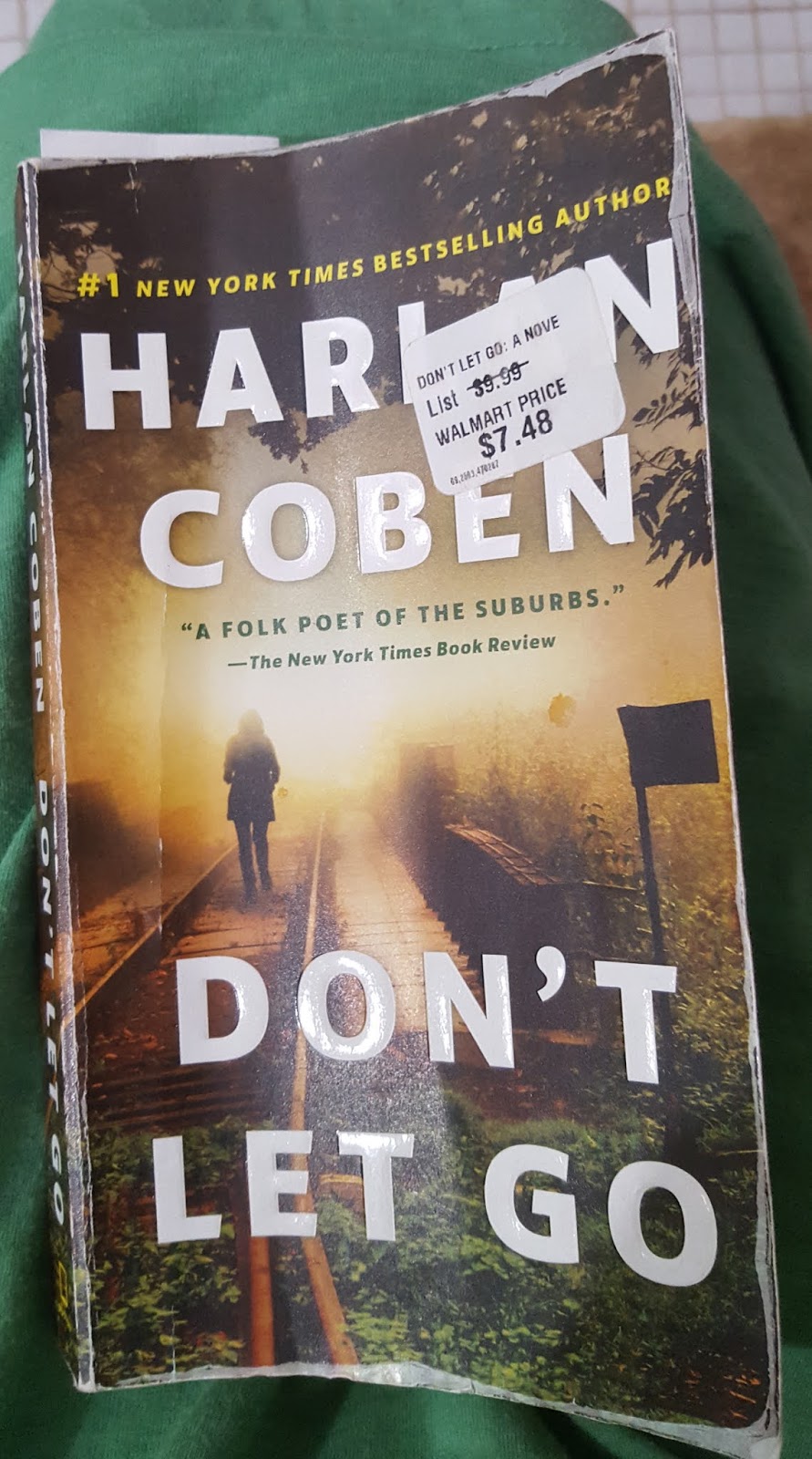
Don't Let Go


Don't Let Go is a stand-alone mystery novel by Harlan Coben. This is the third of his books I've read, and I've enjoyed each one.

from the back of the book:
Suburban New Jersey detective Napoleon "Nap" Dumas hasn't been the same since his senior year of high school, when his twin brother, Leo, and Leo's girlfriend, Diana, were found dead on the railroad tracks -and Maura, the girl Nap considered the love of his life, broke up with him and disappeared without explanation. For fifteen years Nap has been searching, both for Maura and for the real reason behind his brother's death. And now, it looks as though he may finally find what he's been looking for.

When Maura's fingerprints turn up in the rental car of a suspected murderer, Nap embarks on a quest for answers that only leads to more questions -about the woman he loved, about the childhood friends he thought he knew, about the abandoned military base near where he grew up, and mostly about Leo and Diana -whose deaths are darker and far more sinister than Nap ever dared imagine.
Publishers Weekly closes its review with this: "Coben keeps Nap and the reader blindly guessing as he peels back layers of deceit reaching back 15 years, revealing nesting dolls of deadly secrets." Kirkus Reviews also has a review.

Wednesday, July 22, 2020

We've Forgotten More Than We Ever Knew

We've Forgotten More Than We Ever Knew is a 2016 film I watched thinking it was a post-apocalyptic science fiction movie. It's not. It's unclassifiable. The IMDb says, "A Man and a Woman wander through a hostile wilderness in a far-away world. One day, they stumble upon a mysterious set of Structures, which will complicate their lives both for good and ill." I found it thought-provoking. You can watch it online here, or at TubiTV, or on Amazon Prime.

trailer:


Reviews are oddly scarce.

Tuesday, July 21, 2020

Close-Up

Close-Up is a 1948 film noir. This one includes Nazi war criminals.


I always enjoy a drink during a movie, and it's usually coffee:


This photo is from early in 2013, but I've always liked this cup and I'll bet nobody's seen this photo anyway😉


Monday, July 20, 2020

Black Killer

Black Killer is a 1971 Spaghetti Western starring Klaus Kinski. This is not by far the best spaghetti western out there but has Kinski, so it's well worth the 90 minutes you'll spend with it. Even more so if you're a particular fan of the female derriere, which is viewable at the drop of a hat -or should I say skirt.

Sunday, July 19, 2020

Delia's Gone

Delia's Gone:


by Johnny Cash

There's a Memphis mention:
I went up to Memphis
And I met Delia there
Found her in her parlor
And I tied her to her chair
Delia's gone, one more round
Delia's gone

Saturday, July 18, 2020

Tarzan and the Leopard Woman

Tarzan and the Leopard Woman is a 1946 film.

It's a Johnny Weissmuller Tarzan film. I mean, I just never say no to these.


"If an animal can act like a man, why not a man like an animal?"

Friday, July 17, 2020

This Night's Foul Work


This Night's Foul Work by Fred Vargas is the 7th in the Commissaire Adamsberg mystery series. I found this and one other in the series in a used book store months ago and decided to give them a try. I enjoyed this. The characters, in particular, are engaging and the plot fascinating. I'll look for the first one when I can.

from the back of the book:
Two drug dealers are found with their throats cut in the Porte de la Chapelle, Paris, and the narcostics division of the local police is eager to wrap up the case quickly, passing the crime off as a territorial dispute between junkies.But Commissaire Jean-Baptiste Adamsberg's intuition tells him otherwise. He teams up with Dr. Ariane, a pathologist with whom he crossed paths twenty years ago and who believes the murderer is a woman.

As other murders begin to surface, Adamsberg must move quickly to stop the "Angel of Death" from killing again. With her wry narrative touch, Fred Vargas weaves a thrilling and complex mystery filled with memorable characters that will keep readers guessing up to the final page.
The Independent says, "the supreme exponent of this grand-picaresque style is Fred Vargas. Her Commissaire Adamsberg is a magnetic officer who leads a rich intellectual and sexual life, and is beloved by his team. What a baroque collection they are!"

Kirkus Reviews says the author "this time out seems unduly charmed by her own eccentricity". Publishers Weekly has a positive review but thinks the author is male. Careless, that.

Thursday, July 16, 2020

Man, Pride and Vengeance

Man, Pride and Vengeance is 1967 Spaghetti Western film starring Franco Nero and Klaus Kinski. Those two actors are enough to get me to watch a movie. Though it says it's a spaghetti western and that's why we watched it, this had more of a film noir-ish plot. It's an adaptation of the novella Carmen, and is filmed in and set in Europe. You can watch it free with ads online here at Vudu.

trailer:


Spaghetti-Western.net says,
A very interesting film. Very well made and strongly acted. One of the many curiosities include its locale. Unlike many (almost all) spaghetti westerns, this film is not set in New Mexico, Texas, Arizona, or Mexico. It was filmed and set in Andalucia, Spain. This fact alone brings up controversy. Is it a western if it is set in a foreign land? Yes. The theme, characters, and locations suggest that it is a western. It involves smuggling, bandits, and a stagecoach robbery. The robbery scene is particularly well filmed.
...
The film is a very deep and intense character study and thus, focuses more on the characters than the action.
...
good acting, writing, and story
DVD Talk says it "shatters the traditional Spaghetti western template" and that it "ultimately owes more to Bizet than Leone".

Wednesday, July 15, 2020

ATC 42


This is the 42nd Artist Trading Card I ever made.

Tuesday, July 14, 2020

Welcome to Your Authentic Indian Experience™

Welcome to Your Authentic Indian Experience™ is an award-winning 2017 science fiction short story by Rebecca Roanhorse. You can read it online here. It begins,
You maintain a menu of a half dozen Experiences on your digital blackboard, but Vision Quest is the one the Tourists choose the most. That certainly makes your workday easy. All a Vision Quest requires is a dash of mystical shaman, a spirit animal (wolf usually, but birds of prey are on the upswing this year), and the approximation of a peyote experience. Tourists always come out of the Experience feeling spiritually transformed. (You’ve never actually tried peyote, but you did smoke your share of weed during that one year at Arizona State, and who’s going to call you on the difference?) It’s all 101 stuff, really, these Quests. But no other Indian working at Sedona Sweats can do it better. Your sales numbers are tops.

Your wife Theresa doesn’t approve of the gig. Oh, she likes you working, especially after that dismal stretch of unemployment the year before last when she almost left you, but she thinks the job itself is demeaning.

“Our last name’s not Trueblood,” she complains when you tell her about your nom de rêve.

“Nobody wants to buy a Vision Quest from a Jesse Turnblatt,” you explain. “I need to sound more Indian.”

“You are Indian,” she says. “Turnblatt’s Indian-sounding enough because you’re already Indian.”

“We’re not the right kind of Indian,” you counter. “I mean, we’re Catholic, for Christ’s sake.”

What Theresa doesn’t understand is that Tourists don’t want a real Indian experience.
*******

The Daughter came over yesterday afternoon for a wonderful socially distant patio visit and brought a blueberry pie made from scratch. What a treat! And it's sweet of her to think of me :)


Please join me at Bleubeard and Elizabeth's T Stands for Tuesday blogger gathering.

Monday, July 13, 2020

Paul Ferroll: A Tale


Paul Ferroll: A Tale is an 1855 novel by Caroline Clive, who died on this date in 1875 in a fire at the age of 72 years. You can read the book online here. It begins,
“How little we know of what passes in each other’s minds.” -Sidney Smith’s Letters.

PAUL FERROLL.

CHAPTER I.

NOTHING looks more peaceful and secure than a country house seen at early morning. The broad daylight gives the look of safety and protection, and there is the tranquillity of night mixed with the brightness of day, for all is yet silent and at rest about the sleeping house. One glorious July morning saw this calm loveliness brood over the Tower of Mainwarey, a dwelling so called, because the chief part of the building consisted of a square tower many centuries old, about which some well‐fitted additions of the more recent possessors had grouped themselves. It stood in the midst of a garden bright with summer flowers, which at this hour lifted their silver heads all splendid with dew and sunshine; and it looked down the valley to the village, which stood at a little distance, intersected and embowered with orchards, and crowned with the spire of the church. Early as it was, another half hour had not passed before the master of the house descended some steps which led from the window of his dressing‐room, and walked through his blooming garden to the stable, where his horse was ready for him, as it had been every morning for the last few weeks; and whenever the day was beautiful as this was, he had passed the early hours in riding. As he got on horseback, he met a labourer belonging to the gardens coming to his work, and inquired what he was going to do. The man showed a basket of annuals which he was about to plant in the flower‐garden, and being a simple fellow, inquired whether his master could tell if missus meant the blue anagallis or the white to be on the outside of the bed.

“Not I,” said Mr. Ferroll; “whichever you will.”

“Missus will be tremendgious if I’m wrong,” said the man, scratching his head.

Mr. Ferroll frowned at this epithet applied to his young wife, and bidding the man go about his work, rode off.

“It’s well enough for you who have the whip hand,” said Richard Franks, looking after his master; “but if ever a lady provoked the poor wretches under her......” and here his murmurs sank into inarticulate rumbling — but Mr. Ferroll was out of hearing.

He rode gently. The morning was delicious, and he occasionally spoke to a peasant going to his work, or saluted a whole family busy on their garden before the man went to his hired employment. Several of the peasants whom he met while he was still in his own immediate neighbourhood, had a word to speak with him about a job of work they wanted, or repair for a cottage, which they begged his honour to grant. He gave attention and discussed their matters with all, so that he made rather slow progress till he was at some little distance from home, but then he touched his horse with the spurs, and the gallant animal willingly indulged him in the pleasure of a gallop, which he seemed to enjoy with eager relish. He had taken a circuit in his gallop, so that between loitering in his slow pace, and diverging in his quick, it was past six o’clock when he arrived at the village to which his course was directed.

“I’m very early, Mr. Aston,” said he to the farmer at whose house he stopped; “but I knew I must find you at home at this hour.”

“Not a bit too early for us, sir,” said the farmer, “and I’m hugely obliged to you for taking the trouble. It’s all over with me, I believe, sir; but if any can help me, it’s you.”

“When is the day for examining the accounts?” asked Mr. Ferroll.

“To‐morrow week, sir, and I declare I’m as innocent as a babby; and yet there’s a hundred of pounds as I cannot tell what’s gone with him.”

“Did not you keep your accounts like other overseers?” said Ferroll.

“Yes, I did just like the last two told me how; but there’s a great difference now, I believe, sir, in the way the upper people add them up.”

“Maybe so,” said Ferroll; “and do you know there was a great man once in the same plight as you, and Bacon was his name?”

“Pickle, you might have said, sir. Bacon might well be in pickle,” said farmer Aston, laughing heartily.

“Come, that’s well said; I love a man who can laugh under his troubles. I’ve good hope of you. Let’s see these books, these accounts; let me try to add them up the right way for you.”

“Breakfast was just ready if you please, sir,” said the farmer’s wife; “won’t you take a cup of tea and a bit of bread this morning, before you begin?”

“Thank you, I will with pleasure;” and he cut the loaf standing as he was, and ate with appetite the good bread, but rather made less of the tea without milk, seemed the produce of dried grass.

“I’m afraid you don’t like our tea, sir,” said the hostess, “though it’s five‐and‐sixpence a pound at Dewson’s shop.”

“That’s Dewson’s new way of adding up,” said Mr. Ferroll, smiling; “but, thank you, I’m more hungry than thirsty, and you see what a gap I have made in your loaf. So now the books, Aston, and let us set to work.”

The books kept by the overseer were indeed in a state of confusion, which the better order of things in the management of the poor might well find fault with. Farmer Aston, however, had not the least intent of cheating, but he had followed his predecessors’ example in taking the arithmetic of the thing for granted, and forcing a suitable conclusion, when it did not come naturally. Widow Grant appeared at every close where a shilling or a pound could not be accounted for. The things for which the parish was creditor on one side, it was debtor for on another, and at the end of all, to make the expenditure agree with the receipts, appeared his concluding item — “Muddled away £9 4 s shilling . 6½ d pence .”*

Mr. Ferroll set to work to unravel as far as possible this confusion, and patiently listened to the recollection by which the farmer elucidated the written documents. The table was covered with little dirty bills, the summary of which Mr. Ferroll transferred to a fair sheet of paper, and among which he, with a clear head, was pursuing the almost hopeless clue, when the sound of a horse galloping furiously was heard, and a voice asking for God’s sake whether Mr. Ferroll was there. He heard his name, and looked up startled, but finished the calculation he was that moment upon, before he followed the farmer’s wife, who had rushed out of the room, and whom he found fallen on the bench before the door, while the messenger who had come for him stood trembling, and as white as a sheet before her.

“Oh, Lord! here he comes,” cried the matron, as he ran out. “Oh! poor gentleman, don’t tell him, Thomas.”

“What’s the matter?” said Mr. Ferroll, the colour mounting into his own face with expectation. “Speak out this instant.”

“My mistress, sir,” said the fellow, dropping his hands to his side, and the bridle fell loose at the same time, but the panting horse had no inclination to stir.

“Well, your mistress?”

“Dead!” said the man.

Mr. Ferroll’s eyes fixed them on his face, his lips were squeezed together, he did not seem to take in the word.

“She is dead, sir,” said the man; “oh! is worse than dead — they have killed her.”

“Killed your mistress!” he said; “you are mad yourself.”

“How quiet he takes it,” said the woman.

“He don’t believe it,” said the messenger. “Sir, she’s been murdered in her bed.”

Mr. Ferroll said not a word more; he asked not another question; but he walked like a drunken man to the stable, where his own horse was put up; and springing into the saddle, flew past the cottage almost like the speed of a bird, and vanished from their sight on the way home.

Home! and what a home! It was all peace and stillness when he left it. It was a scene of distraction, now — servants and villagers were about the door, and in the garden. Men were rushing for help, and only bringing more trembling spectators; the gate was wide open; the windows, some still barred, some thrown up; household employments all broken off — the household hurriedly one on another, terrified out of their senses.

They rushed to their master, when he arrived.

“What is the matter?” he said again, as if his apprehension refused all belief of what he had heard.

“It’s all true, sir,” said the constable, who had been secured among the rest. “Your lady has been murdered.”

Mr. Ferroll was a man of powerful will and habitual reserve; he seemed to force himself to an action he abhorred — turned towards the room.

“You had better not go in,” said the constable, holding his arm.

“Seeing it is not the worst part,” said Mr. Ferroll, and went on.

*******

I confess I didn't finish it. I made it to about the half-way point before I began skimming and then quit entirely.

Sunday, July 12, 2020

Daughter of Horror

Daughter of Horror is a 1955 American horror film. Dementia the parent film, had no dialog but a soundtrack was added later. Added narration and some editing resulted in the Daughter of Horror release.

DVD Talk calls the added words "a tone poem," saying
If you don't care for mini-budgeted, dank and creepy, old and eeky horror films that crawl out from under rocks, well, Dementia /Daughter of Horror might not be your glass of tea. Finally seeing it in a version that doesn't require night-vision goggles was truly a thrill - maybe some films must be coveted for 30 years, to work up an appropriate lack of perspective!


TCM has an interesting article which includes this:
As critic Gary Don Rhodes notes: "The real horror in Daughter of Horror is the threat of women's resistance to their own objectification and abuse. Such resistance could be figured for audiences in the 1950s perhaps most vividly within the generic space of the horror film and encoded in the language of mental disease because these provided conceptual frameworks that could limit and contain the implications of the film." A woman who takes up arms against the cruelty of her father or the sexual exploitation of predatory men is a direct threat to the accepted sex roles of the 1950s. Thanks to a little mayonnaise in the form of McMahon's narration, such subversion became palatable.
366 Weird Movies has some fascinating background information, including this:
  • The film [Dementia] contains no dialogue, although it’s not technically a silent film as some sound effects can be heard.
  • Director John Parker has only Dementia and one short film (a dry run for this feature) in his filmography. We know little about him except that his parents were in the film distribution business.
  • Star Adrienne Barrett was Parker’s secretary, and the film was inspired by a nightmare she related to Parker.
...
  • After failing to find success in its original dialogue-free form, Dementia was re-released in 1957 with narration (from future late night talk show sidekick Ed McMahon) and retitled Daughter of Horror.
  • Daughter of Horror is the movie teenagers are watching in the theater when the monster strikes in The Blob.