Seven Brides for Seven Brothers is a 1954 musical film, a light-hearted romp on the subject of marriage by rape. Yes, this is a movie that hasn't aged well, not at all. I watched it on HBO Max. It's listed in the book 1001 Movies You Must See Before You Die.
trailer:
Empire Online concludes by saying, "Great songs, great set pieces and solid performances in this colourful and infectiously enjoyable musical." Variety calls it "a happy, hand-clapping, foot-stomping country type of musical with all the slickness of a Broadway show." Rotten Tomatoes has a critics consensus score of 89%.
Sunday, July 31, 2022


Saturday, July 30, 2022
Rebel Without a Cause
Rebel Without a Cause is a 1955 film, a type of coming-of-age film about suburban, middle-class teens. It's directed by Nicholas Ray and stars James Dean, Natalie Wood, Sal Mineo, Jim Backus, Dennis Hopper, and Edward Platt. I'd never seen anything but a few clips of this movie before and watched it because it's listed in the book 1001 Movies You Must See Before You Die. It's a tough watch. Give me a standard horror movie any day over these deep dives into family dysfuction and societal breakdown That's the real horror. I watched it on HBO Max where I've found quite a few of the movies listed in that book.
trailer:
The Hollywood Reporter opens its review with this: "On Oct. 27, 1955, Warner Bros. released a teenage drama, 'Rebel Without a Cause,' just a month after star James Dean's untimely death in an automobile accident." Variety has an article. The Guardian opens by saying, "There is some stuffy, faintly reactionary stuff in this famed 1955 teen drama, but James Dean is truly extraordinary, and it has some brilliant scenes".
Film Site says,
trailer:
The Hollywood Reporter opens its review with this: "On Oct. 27, 1955, Warner Bros. released a teenage drama, 'Rebel Without a Cause,' just a month after star James Dean's untimely death in an automobile accident." Variety has an article. The Guardian opens by saying, "There is some stuffy, faintly reactionary stuff in this famed 1955 teen drama, but James Dean is truly extraordinary, and it has some brilliant scenes".
Film Site says,
The tale of youthful defiance, which could have been exploitative - but wasn't, provides a rich, but stylized (and partly out-dated) look at the world of the conformist mid-1950s from the perspective of the main adolescent male character - a troubled teen with ineffectual parents, who faces a new school environment.Roger Ebert says,
The film has not aged well, and Dean's performance seems more like marked-down Brando than the birth of an important talent. But "Rebel Without a Cause" was enormously influential at the time, a milestone in the creation of new idea about young people.Rotten Tomatoes has a critics consensus score of 93%.
Friday, July 29, 2022
North by Northwest
North by Northwest is a 1959 thriller film directed by Alfred Hitchcock and starring Cary Grant, Eva Marie Saint, and James Mason. This isn't my favorite Hitchcock by any means, but I watched it again for James Mason. Also in this are Leo G. Carroll, Martin Landau, and Edward Platt. I saw it on HBO Max.
trailer:
Film Site opens with this: "North by Northwest (1959) is a suspenseful, classic Alfred Hitchcock caper thriller. The box-office hit film is one of the most entertaining movies ever made and one of Hitchcock's most famous suspense/mystery stories in his entire career." The New Yorker has a positive review from the time of the film's release.
The Hollywood Reporter concludes a review from 1959 by saying, "This film is pure entertainment." Deep Focus Review has an interesting article that opens with this: "North by Northwest distills Alfred Hitchcock’s obsessions, techniques, and themes into a singular, deliriously entertaining form." It's listed in the book 1001 Movies You Must See Before You Buy. Rotten Tomatoes has a critics consensus score of 98%.
trailer:
Film Site opens with this: "North by Northwest (1959) is a suspenseful, classic Alfred Hitchcock caper thriller. The box-office hit film is one of the most entertaining movies ever made and one of Hitchcock's most famous suspense/mystery stories in his entire career." The New Yorker has a positive review from the time of the film's release.
The Hollywood Reporter concludes a review from 1959 by saying, "This film is pure entertainment." Deep Focus Review has an interesting article that opens with this: "North by Northwest distills Alfred Hitchcock’s obsessions, techniques, and themes into a singular, deliriously entertaining form." It's listed in the book 1001 Movies You Must See Before You Buy. Rotten Tomatoes has a critics consensus score of 98%.
(I keep randomly getting "you've commented on too many posts today; try again tomorrow" flags when I try to leave a comment on some blog posts. Sometimes it accepts my comments but not always. If there's a work-around I don't know about it.)
Thursday, July 28, 2022
Wednesday, July 27, 2022
A Star Is Born (1954)
A Star Is Born is the 1954 George Cukor film starring Judy Garland and James Mason. I'm posting this in memory of Mason, who died of a heart attack on this date in 1984 at the age of 76. Mason is one of those actors I look for. If he's in a movie that's reason enough for me to watch it. I watched this on HBO Max.
trailer:
Film Site opens with this:
trailer:
Film Site opens with this:
A Star is Born is the superb 1954 dramatic musical and tearjerker, acclaimed by many as the greatest Hollywood musical ever made. Judy Garland's intense performance as the main character, probably the finest of her entire career, ...Roger Ebert's site says it's still the best of the 5 films telling this story. 98% of Rotten Tomatoes critics reviewing this film gave it a positive review.
Tuesday, July 26, 2022
Madame Lemmen in a Flowery Interior
Madame Lemmen in a Flowery Interior (1913):

by Georges Lemmen. See that pretty cup? This was going to be my entry for this week's T Stands for Tuesday blogger gathering. Looks like I won't be able to come this week, but I'll see y'all next week God willing and the creek don't rise...

by Georges Lemmen. See that pretty cup? This was going to be my entry for this week's T Stands for Tuesday blogger gathering. Looks like I won't be able to come this week, but I'll see y'all next week God willing and the creek don't rise...
Monday, July 25, 2022
West Side Story (1961)
West Side Story is a 1961 Robert Wise/Jerome Robbins musical film, one of the greatest musical films of all time and perhaps the best. I have the DVD but watched it on HBO Max this time. If you haven't seen this it it definitely a must see. And not just for the music but also for the plot.
trailer:
trailer:
Sunday, July 24, 2022
#Alive
#Alive is a 2020 South Korean Zombie film. I watched it on Netflix.
trailer:
Rotten Tomatoes has a critics consensus score of 86%. Roger Ebert's site says, "despite a relatable depiction of one man quarantining from a deadly virus, it's the blood-covered zombies who are much more fun to watch."
trailer:
Rotten Tomatoes has a critics consensus score of 86%. Roger Ebert's site says, "despite a relatable depiction of one man quarantining from a deadly virus, it's the blood-covered zombies who are much more fun to watch."
Saturday, July 23, 2022
Scoop
Scoop is a 1938 satiric novel by Evelyn Waugh. I got a kick out of this one.
Plot description from Wikipedia:
Plot description from Wikipedia:
William Boot, a young man who lives in genteel poverty, far from the iniquities of London, contributes nature notes to Lord Copper's Daily Beast, a national daily newspaper. He is dragooned into becoming a foreign correspondent, when the editors mistake him for John Courteney Boot, a fashionable novelist and a remote cousin. He is sent to Ishmaelia, a fictional state in East Africa, to report on the crisis there.You can read it online at this link or have it read to you at the bottom of this post. It begins,
BOOK ONE
The Stitch Service
Chapter One
While still a young man, John Courteney Boot had, as his publisher proclaimed, ‘achieved an assured and enviable position in contemporary letters’. His novels sold fifteen thousand copies in their first year and were read by the people whose opinion John Boot respected. Between novels he kept his name sweet in intellectual circles with unprofitable but modish works on history and travel. His signed first editions sometimes changed hands at a shilling or two above their original price. He had published eight books—(beginning with a life of Rimbaud written when he was eighteen, and concluding, at the moment, with Waste of Time, a studiously modest description of some harrowing months among the Patagonian Indians)—of which most people who lunched with Lady Metroland could remember the names of three or four. He had many charming friends of whom the most valued was the lovely Mrs Algernon Stitch.
Like all in her circle John Boot habitually brought his difficulties to her for solution. It was with this purpose, on a biting-cold mid-June morning, that he crossed the Park and called at her house (a superb creation by Nicholas Hawksmoor modestly concealed in a cul-de-sac near Saint James’s Palace).
Algernon Stitch was standing in the hall; his bowler hat was on his head; his right hand, grasping a crimson, royally emblazoned despatch case, emerged from the left sleeve of his overcoat; his other hand burrowed petulantly in his breast pocket. An umbrella under his left arm further inconvenienced him. He spoke indistinctly, for he was holding a folded copy of the morning paper between his teeth.
‘Can’t get it on,’ he seemed to say.
The man who had opened the door came to his assistance, removed the umbrella and despatch case and laid them on the marble table; removed the coat and held it behind his master. John took the newspaper.
‘Thanks. Thanks very much. Much obliged. Come to see Julia, eh?’
From high overhead, down the majestic curves of the great staircase, came a small but preternaturally resonant voice.
‘Try not to be late for dinner, Algy; the Kents are coming.’
‘She’s upstairs,’ said Stitch. He had his coat on now and looked fully an English cabinet minister; long and thin, with a long, thin nose, and long, thin moustaches; the ideal model for continental caricaturists. ‘You’ll find her in bed,’ he said.
‘Your speech reads very well this morning.’ John was always polite to Stitch; everybody was; Labour members loved him.
‘Speech? Mine? Ah. Reads well, eh? Sounded terrible to me. Thanks all the same. Thanks very much. Much obliged.’
So Stitch went out to the Ministry of Imperial Defence and John went up to see Julia.
As her husband had told him, she was still in bed although it was past eleven o’clock. Her normally mobile face encased in clay was rigid and menacing as an Aztec mask. But she was not resting. Her secretary, Miss Holloway, sat at her side with account books, bills and correspondence. With one hand Mrs Stitch was signing cheques; with the other she held the telephone to which, at the moment, she was dictating details of the costumes for a charity ballet. An elegant young man at the top of a step-ladder was painting ruined castles on the ceiling. Josephine, the eight year old Stitch prodigy, sat on the foot of the bed construing her day’s passage of Virgil. Mrs Stitch’s maid, Brittling, was reading her the clues of the morning crossword. She had been hard at it since half-past seven.
Josephine rose from her lesson to kick John as he entered. ‘Boot,’ she said savagely, ‘Boot’ catching him first on one knee cap, then on the other. It was a joke of long standing.
Mrs Stitch turned her face of clay, in which only the eyes gave a suggestion of welcome, towards her visitor.
‘Come in,’ she said, ‘I’m just going out. Why twenty pounds to Mrs Beaver?’
‘That was for Lady Jean’s wedding present,’ said Miss Holloway.
‘I must have been insane. About the lion’s head for the centurion’s breastplate; there’s a beautiful one over the gate of a house near Salisbury, called Twisbury Manor; copy that as near as you can; ring up Country Life and ask for “back numbers”, there was a photograph of it about two years ago. You’re putting too much ivy on the turret, Arthur; the owl won’t show up unless you have him on the bare stone and I’m particularly attached to the owl. Munera, darling, like tumtiddy; always a short a in neuter plurals. It sounds like an anagram; see if “Terracotta” fits. I’m delighted to see you, John. Where have you been? You can come and buy carpets with me; I’ve found a new shop in Bethnal Green, kept by a very interesting Jew who speaks no English; the most extraordinary things keep happening to his sister. Why should I go to Viola Chasm’s Distressed Area; did she come to my Model Madhouse?’
‘Oh, yes, Mrs Stitch.’
‘Then I suppose it means two guineas. I absolutely loved Waste of Time. We read it aloud at Blackewell. The headless abbot is grand.’
‘Headless abbot?’
‘Not in Wasters. On Arthur’s ceiling. I put it in the Prime Minister’s bedroom.’
‘Did he read it?’
‘Well I don’t think he reads much.’
‘Terracotta is too long, madam, and there is no r.’
‘Try hottentot. It’s that kind of word. I can never do anagrams unless I can see them. No Twisbury, you must have heard of it.’
‘Floribus Austrum,’ Josephine chanted, ‘perditus et liquidis immisi fontibus apros; having been lost with flowers in the South and sent into the liquid fountains; apros is wild boars but I couldn’t quite make sense of that bit.’
‘We’ll do it tomorrow. I’ve got to go out now. Is “hottentot” any use?’
‘No h, madam,’ said Brittling with ineffable gloom.
‘Oh, dear. I must look at it in my bath. I shall only be ten minutes. Stay and talk to Josephine.’
She was out of bed and out of the room. Brittling followed. Miss Holloway collected the cheques and papers. The young man on the ladder dabbed away industriously. Josephine rolled to the head of the bed and stared up at him.
‘It’s very banal, isn’t it, Boot?’
‘I like it very much.’
‘Do you? I think all Arthur’s work is banal. I read your book Waste of Time.’
‘Ah.’ John did not invite criticism.
‘I thought it very banal.’
‘You seem to find everything banal.’
‘It is a new word whose correct use I have only lately learnt,’ said Josephine with dignity. ‘I find it applies to nearly everything; Virgil and Miss Brittling and my gymnasium.’
‘How is the gymnasium going?’
‘I am by far the best of my class although there are several girls older than me and two middle-class boys.’
When Mrs Stitch said ten minutes, she meant ten minutes. Sharp on time she was back, dressed for the street; her lovely face, scraped clean of clay, was now alive with interest.
‘Sweet Josephine, has Mr Boot been boring you?’
‘It was all right really. I did most of the talking.’
‘Show him your imitation of the Prime Minister.’
‘No.’
‘Sing him your Neapolitan song.’
‘No.’
‘Stand on your head. Just once for Mr Boot.’
‘No.’
‘Oh dear. Well we must go at once if we are to get to Bethnal Green and back before luncheon. The traffic’s terrible.’
Algernon Stitch went to his office in a sombre and rather antiquated Daimler; Julia always drove herself, in the latest model of mass-produced, baby car; brand-new twice a year, painted an invariable brilliant black, tiny and glossy as a midget’s funeral hearse. She mounted the kerb and bowled rapidly along the pavement to the corner of St James’s, where a policeman took her number and ordered her into the road.
‘Third time this week,’ said Mrs Stitch. ‘I wish they wouldn’t. It’s such a nuisance for Algy.’
Once embedded in the traffic block, she stopped the engine and turned her attention to the crossword.
‘It’s “detonated”,’ she said, filling it in.
East wind swept the street, carrying with it the exhaust-gas of a hundred motors and coarse particles of Regency stucco from a once decent Nash façade that was being demolished across the way. John shivered and rubbed some grit further into his eye. Eight minutes close application was enough to finish the puzzle. Mrs Stitch folded the paper and tossed it over her shoulder into the back seat; looked about her resentfully at the stationary traffic.
‘This is too much,’ she said; started the engine, turned sharp again onto the kerb and proceeded to Piccadilly, driving before her at a brisk pace, until he took refuge on the step of Brook’s, a portly, bald young man; when he reached safety, he turned to remonstrate, recognized Mrs Stitch, and bowed profoundly to the tiny, black back as it shot the corner of Arlington Street. ‘One of the things I like about these absurd cars,’ she said, ‘is that you can do things with them that you couldn’t do in a real one.’
From Hyde Park Corner to Piccadilly Circus the line of traffic was continuous and motionless, still as a photograph, unbroken and undisturbed save at a few strategic corners where barricaded navvies, like desperate outposts of some proletarian defence, were rending the road with mechanical drills, mining for the wires and tubes that controlled the life of the city.
‘I want to get away from London,’ said John Boot.
‘So it’s come to that? All on account of your American girl?’
‘Well, mostly.’
‘I warned you, before you began. Is she being frightful?’
‘My lips are sealed. But I’ve got to get far away or else go crazy.’
‘To my certain knowledge she’s driven three men into the bin. Where are you going?’
‘That’s just what I wanted to talk about.’
The line of cars jerked forwards for ten yards and again came to rest. The lunch-time edition of the evening papers was already on the streets; placards announcingISHMAELITE CRISISandSTRONG LEAGUE NOTE
were fluttering in the east wind.
‘Ishmaelia seems to be the place. I was wondering if Algy would send me there as a spy.’
‘Not a chance.’
‘No?’
‘Foregonners. Algy’s been sacking ten spies a day for weeks. It’s a grossly overcrowded profession. Why don’t you go as a war correspondent?’
‘Could you fix it?’
...
*******
Friday, July 22, 2022
Gunfight at the O.K. Corral
Gunfight at the O.K. Corral is a 1957 John Sturges western film telling the story of the famous gunfight. It stars Burt Lancaster, Kirk Douglas, John Ireland, Dennis Hopper, Whit Bissell, DeForrest Kelley, Lee Van Cleef, and Jack Elam. I watched it on Amazon Prime.
trailer:
It's included in the book 1001 Movies You Must See Before You Die. The Rotten Tomatoes consensus score is 85%.
trailer:
It's included in the book 1001 Movies You Must See Before You Die. The Rotten Tomatoes consensus score is 85%.
Thursday, July 21, 2022
Fantastic Beasts: The Secrets of Dumbledore
Fantastic Beasts: The Secrets of Dumbledore is a 2022 fantasy film, the latest in the Harry Potter series. It's fine, but unless you're a big Harry Potter fan I suggest you choose something else. I watched it on HBO Max.
trailer:
It didn't fare well with professional reviewers.
trailer:
It didn't fare well with professional reviewers.
Wednesday, July 20, 2022
His Name Was King
His Name Was King is a 1971 spaghetti western starring Richard Harrison and Klaus Kinski. Kinski is a favorite, and I'll watch anything based on his presence alone. I saw this free on Tubi.
You can also watch it via YouTube:
You can also watch it via YouTube:
Tuesday, July 19, 2022
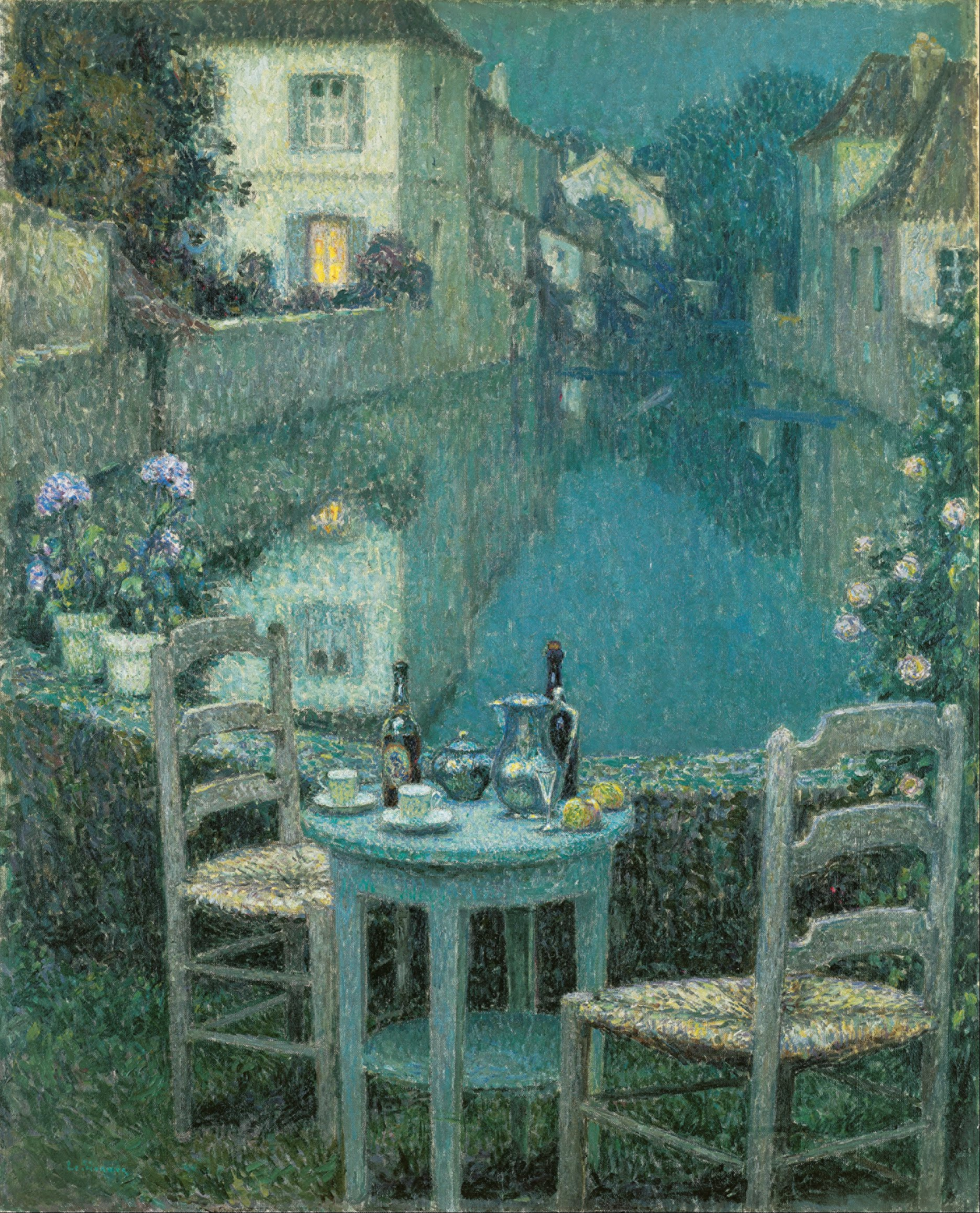
Small Table in Evening Dusk
Small Table in Evening Dusk:
 by Henri le Sidaner, an intimist painter known for his paintings of domestic interiors and quiet street scenes, who died on July 14 in 1939 at the age of 76.
You can enjoy a 2 minute virtual visit to his garden here:
Please post a drink reference of your own and join in the T Stands for Tuesday blogger gathering.
You can enjoy a 2 minute virtual visit to his garden here:
Please post a drink reference of your own and join in the T Stands for Tuesday blogger gathering.
Monday, July 18, 2022
Sunday, July 17, 2022
The Asphalt Jungle
The Asphalt Jungle is a 1950 heist film directed by John Huston and starring Sterling Hayden, James Whitmore, Sam Jaffe (always worth watching), and Marilyn Monroe (in one of her earliest roles). It is considered one of the most influential films in the genre. It's listed in the book 1001 Movies You Must See Before You Die. I watched it on HBO Max.
trailer:
The Guardian says,
trailer:
The Guardian says,
The Asphalt Jungle is the greatest, most influential heist movie, and has a superb performance from Sam Jaffe as the middle-aged German-born criminal mastermind behind a million-dollar jewel robbery in an unidentified American city. It differs from most caper films in creating a whole world where the carefully delineated crooks are mirror images of the supposedly respectable society they challenge. The film's crucial line is spoken by the suave lawyer (Louis Calhern) who bankrolls the robbery: 'After all, crime is only a left-hand form of human endeavour.'Film Site has an interesting article and a detailed plot description. Slant Magazine has a positive review. Empire Online gives it 5 out of 5 stars, calls it "a seminal influence on crime pictures to this day, and concludes, "A tight plot that's enriched by wonderfully crafted characters that each have their own key weaknesses." Rotten Tomatoes has a critics consensus score of 97%.
Saturday, July 16, 2022

Friday, July 15, 2022
Ringo and His Golden Pistol
Ringo and His Golden Pistol is a 1966 spaghetti western directed by Sergio Corbucci, whose first commercial success was with the cult spaghetti western Django. Spaghetti westerns are great for mindless entertainment. I watched it on HBO Max.
trailer:
trailer:
Thursday, July 14, 2022
Agatha Christie's Seven Dials Mystery
Agatha Christie's Seven Dials Mystery is a faithful 1981 film adaptation of the book. I enjoyed it but found this more complex in plot than other Christie adaptations I've seen. I watched it on BritBox on Amazon Prime.
trailer:
trailer:
*******
You can read the book free online here or here or listen to it read to you at this YouTube link. It begins,
One
ON EARLY RISING
That amiable youth, Jimmy Thesiger, came racing down the big staircase at Chimneys two steps at a time. So precipitate was his descent that he collided with Tredwell, the stately butler, just as the latter was crossing the hall bearing a fresh supply of hot coffee. Owing to the marvellous presence of mind and masterly agility of Tredwell, no casualty occurred.
“Sorry,” apologized Jimmy. “I say, Tredwell, am I the last down?”
“No, sir. Mr. Wade has not come down yet.”
“Good,” said Jimmy, and entered the breakfast room.
The room was empty save for his hostess, and her reproachful gaze gave Jimmy the same feeling of discomfort he always experienced on catching the eye of a defunct codfish exposed on a fisherman’s slab. Yet, hang it all, why should the woman look at him like that? To come down at a punctual nine thirty when staying in a country house simply wasn’t done. To be sure, it was now a quarter past eleven which was, perhaps, the outside limit, but even then —
“Afraid I’m a bit late, Lady Coote. What?”
“Oh, it doesn’t matter,” said Lady Coote in a melancholy voice.
As a matter of fact, people being late for breakfast worried her very much. For the first ten years of her married life, Sir Oswald Coote (then plain Mr.) had, to put it badly, raised hell if his morning meal were even a half minute later than eight o’clock. Lady Coote had been disciplined to regard unpunctuality as a deadly sin of the most unpardonable nature. And habit dies hard. Also, she was an earnest woman, and she could not help asking herself what possible good these young people would ever do in the world without early rising. As Sir Oswald so often said, to reporters and others: “I attribute my success entirely to my habits of early rising, frugal living, and methodical habits.”
Lady Coote was a big, handsome woman in a tragic sort of fashion. She had large, mournful eyes and a deep voice. An artist looking for a model for “Rachel mourning for her children” would have hailed Lady Coote with delight. She would have done well, too, in melodrama, staggering through the falling snow as the deeply wronged wife of the villain.
She looked as though she had some terrible secret sorrow in her life, and yet if the truth be told, Lady Coote had had no trouble in her life whatever, except the meteoric rise to prosperity of Sir Oswald. As a young girl she had been a jolly flamboyant creature, very much in love with Oswald Coote, the aspiring young man in the bicycle shop next to her father’s hardware store. They had lived very happily, first in a couple of rooms, and then in a tiny house, and then in a larger house, and then in successive houses of increasing magnitude, but always within a reasonable distance of “the Works,” until now Sir Oswald had reached such an eminence that he and “the Works” were no longer interdependent, and it was his pleasure to rent the very largest and most magnificent mansions available all over England. Chimneys was a historic place, and in renting it from the Marquis of Caterham for two years, Sir Oswald felt that he had attained the top notch of his ambition.
Lady Coote was not nearly so happy about it. She was a lonely woman. The principal relaxation of her early married life had been talking to “the girl” —and even when “the girl” had been multiplied by three, conversation with her domestic staff had still been the principal distraction of Lady Coote’s day. Now, with a pack of housemaids, a butler like an archbishop, several footmen of imposing proportions, a bevy of scuttling kitchen and scullery maids, a terrifying foreign chef with a “temperament,” and a housekeeper of immense proportions who alternately creaked and rustled when she moved, Lady Coote was as one marooned on a desert island.
She sighed now, heavily, and drifted out through the open window, much to the relief of Jimmy Thesiger, who at once helped himself to more kidneys and bacon on the strength of it.
...
Wednesday, July 13, 2022
Shoot the Piano Player
Shoot the Piano Player is a 1960 French New Wave crime film directed by François Truffaut. I watched it on HBO Max.
trailer:
AV Club opens its positive review with this:
trailer:
AV Club opens its positive review with this:
Over the course of 81 of the briskest minutes in cinema, François Truffaut's Shoot The Piano Player contains flashbacks, jump-cuts, weird superimpositions, tender love scenes, broad slapstick, a snowbound shootout with feckless gangsters, a sing-along in a Parisian piano bar, and countless nods to American noirs and genre films. Truffaut himself claimed that his exhilarating second feature could be heard as a love story and viewed as a gangster noir, though it's a thrill to witness these aural and visual elements smashed together.Senses of Cinema calls it "a cheerfully ramshackle affair, alternately light and serious, a playful film". Empire Online gives it 5 out of 5 stars and concludes by saying it is "A superb combination of genre movie and Truffaut's special brand of perfectly observed, humanist detail." Rotten Tomatoes has a critics score of 91%. It's listed in the book 1001 Movies You Must See Before You Die.
Tuesday, July 12, 2022
La Table, Printemps
La Table, Printemps:
 by Henri Le Sidener, who died on July 14, 1939.
Please share your own drink reference and join us at the T Stands for Tuesday blogger gathering.

Please share your own drink reference and join us at the T Stands for Tuesday blogger gathering.
Subscribe to:
Posts (Atom)

 Posts
Posts


